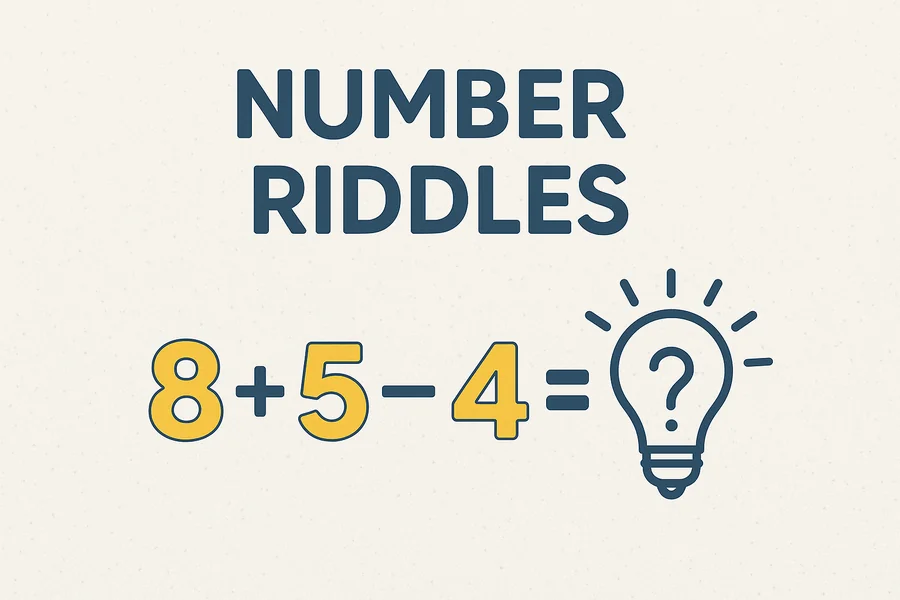
Riddles are always an excellent method of brainwork, critical thinking, and fun simultaneously. Another way to improve your mathematical reasoning and problem-solving skills is through number riddles, especially. These challenges then challenge your reasoning, pattern identification skills, and imagination of number treatment. You are a math lover, or you need to do some exercise to your brain, these number riddles are going to entertain and make you active.
Why Number Riddles Matter
Number riddles serve as more than just entertainment. They help improve various cognitive skills, including:
• Logical thinking
• Pattern recognition
• Analytical reasoning
• Problem-solving skills
• Mental agility
By playing with these puzzles, your mathematical intuition is improved, and it will be useful not only in everyday life but also in a career. Moreover, there is a sense of fulfillment in solving number riddles. when you have finally figured out the code.
The Possible Shaping of your brain with Number Riddles
Whenever you get a new number riddle you try to make your brain think in a different way. Such riddles usually make you think out of the box and get off the usual problem-solving techniques. No matter the level of basic arithmetic, geometric patterns, or algebraic equations, number riddles encourage the student to learn more about how numbers interrelate and how solutions may be discovered in an unintuitive manner.
When you figure out these puzzles, not only do you train your mind to think more analytically, but you also train your mind to be creative and tenacious in solving problems.
50+ Number Riddles to Challenge Your Brain
Ready to put your brain to the test? Below are 50+ number riddles that will challenge your thinking. Try to solve them without peeking at the answers!
- What comes next in the series: 2, 6, 12, 20, ___?
- I am an odd number. Take away one letter, and I become even. What number am I?
- If two’s company and three’s a crowd, what are four and five?
- What number has the same number of letters as its value?
- I am a three-digit number. My tens digit is five more than my ones digit, and my hundreds digit is eight less than my tens digit. What number am I?
- What’s the smallest number that is divisible by 2, 3, and 5?
- I am thinking of a number. Multiply it by 2, then subtract 4. The result is 12. What number am I thinking of?
- What number is one less than the square of 10?
- I am a two-digit number. The sum of my digits is 12, and my tens digit is greater than my ones digit. What number am I?
- How many times can you subtract 10 from 100?
- What is the next number in the sequence: 1, 1, 2, 6, 24, ___?
- If I am half of 20, and you add 5 to me, what do you get?
- I am a number. If you multiply me by 6, you get 36. What number am I?
- If you divide 50 by 2 and add 10, what do you get?
- I am a number. Take away one letter, and I become ten. What number am I?
- What comes next in the series: 5, 10, 20, 40, ___?
- What is the sum of the numbers from 1 to 100?
- I am a number that is divisible by 7 and 11. What number am I?
- I am a four-digit number. The sum of my digits is 15, and the product is 120. What number am I?
- If I’m multiplied by 3, I become 21. What number am I?
- What is the next number in the series: 1, 2, 4, 8, 16, ___?
- I am a number that is greater than 100 but less than 200. My ones digit is 3, and my tens digit is 4. What number am I?
- If a dozen eggs costs $2, how much does 3 dozen eggs cost?
- I am thinking of a number. Add 7 to me, then divide the result by 5. You get 4. What number am I thinking of?
- What is the next number in the sequence: 1, 3, 6, 10, 15, ___?
- If I have 3 apples and give 1 to my friend, how many apples do I have left?
- What’s the sum of all odd numbers from 1 to 99?
- I am a number that is divisible by 9 and 11. What number am I?
- If I am a square number, what number am I if my square root is 8?
- How many seconds are in an hour?
- What number is half of 1000?
- I am a number that is both prime and a square. What number am I?
- What comes next in the sequence: 1, 4, 9, 16, ___?
- I am a number between 50 and 60. The sum of my digits is 9. What number am I?
- If you multiply me by 3 and subtract 4, the result is 8. What number am I?
- What number is one more than the product of 5 and 7?
- If a person is 25 years old today, how old will they be in 10 years?
- I am a number. If you subtract 3 from me, I become 11. What number am I?
- How many sides does a hexagon have?
- What number is one less than the square of 12?
- I am a three-digit number. My tens digit is 3, my ones digit is 5, and my hundreds digit is 1. What number am I?
- How many months are in a year?
- If you multiply a number by itself, what type of number do you get?
- What number is both a multiple of 4 and 6?
- I am a number. If you divide me by 5, I become 2. What number am I?
- If I’m added to 7, my result is 15. What number am I?
- What comes next in the sequence: 1, 1, 2, 6, 24, 120, ___?
- I am thinking of a number. Add 10 to me, then divide by 2. The result is 12. What number am I?
- How many days are in a year?
- What number is one more than the square of 6?
- I am a number between 100 and 200. My tens digit is 4, and my ones digit is 7. What number am I?
- What number is half of 90?
- If you subtract 9 from me, I become 5. What number am I?
- What number is twice the sum of 6 and 4?
- If you divide 81 by 9, what do you get?
- What comes next in the sequence: 2, 4, 8, 16, ___?
- What’s the product of 12 and 11?
- I am a number that is divisible by both 3 and 5. What number am I?
- What number is half of 200?
- What’s the next number in the sequence: 2, 4, 8, 16, 32, ___?
The Role of Number Riddles in Mental Agility

Number riddles will improve your problem-solving abilities and brain capacity. Every riddle is a challenge of its own, be it the calculation, patterns or reasoning. Such puzzles engage different components of the brain, stimulating memory, critical thinking and reasoning skills.
Conclusion
Not only riddles with numbers are fun and entertaining but also a very good means of exercising your head and enhancing cognitive skills. In solving these difficult puzzles, you will acquire a stronger concept of number interaction and become more proficient in solving problems. Any need to pass the time, work your brain, or just have fun with a good puzzle, number riddles are the best chance to stretch your brain muscles, and not just have fun in the process!
FAQs
Why should I try number riddles?
They improve your logical thinking, pattern recognition, and problem-solving skills.
Can number riddles make me smarter?
Yes, they engage various cognitive functions, enhancing your mental agility and critical thinking.
Are number riddles suitable for all ages?
Absolutely! There are number riddles for all skill levels, making them fun for both kids and adults.
Can I use number riddles to practice math?
Yes, number riddles are a great way to reinforce your mathematical skills and sharpen your mind.
How often should I practice number riddles?
Regular practice, even once or twice a week, can improve your problem-solving abilities and mental agility.
Can number riddles be shared with others?
Yes, sharing number riddles with friends and family is a fun way to engage together and foster healthy competition.