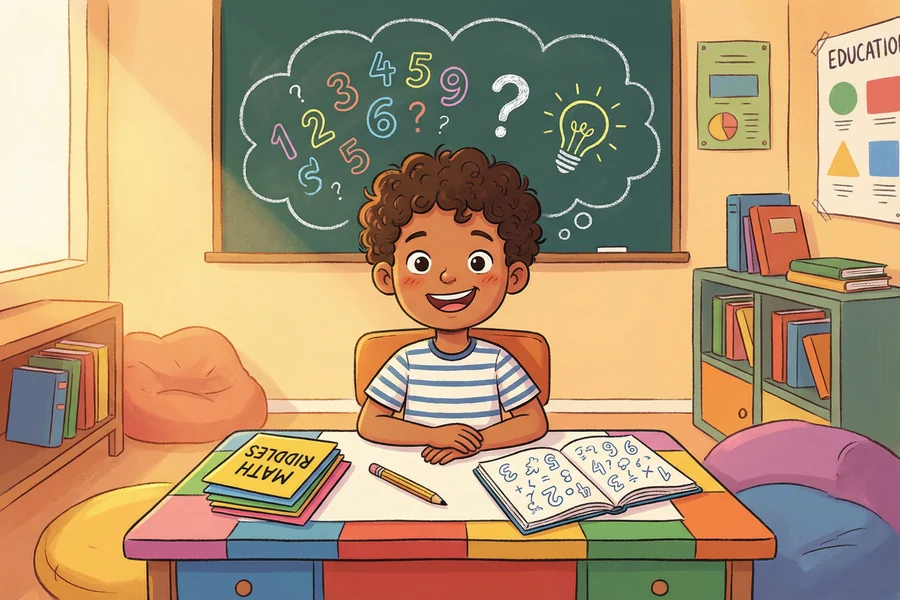
Getting kids excited about maths? Sometimes it feels impossible. But I’ve watched this happen over and over: a child who groans at their workbook will suddenly perk up when you frame the exact same problem as a riddle. Something about that playful twist flips a switch in their head.
Math riddles sneak learning past your child’s defences. They’re having so much fun cracking the puzzle that they forget they’re actually practising number patterns and logical thinking. It’s homework disguised as playtime, and it works surprisingly well.
How Puzzles Build Mathematical Thinking
There’s solid research backing this up. Stanford University’s mathematics education department found that kids who learn through play develop stronger understanding than those who only do traditional drills. Makes sense when you think about it.
Watch what happens when your child tackles a tough riddle. They’re reading carefully, looking for patterns, trying different angles, backing up when they hit dead ends. That’s not just puzzle-solving. That’s exactly how good mathematicians think.
Easy Math Riddles for Younger Children (P1-P3)
Here are some riddles that work great for younger kids who are still getting comfortable with basic sums.
Riddle 1: I am an odd number. Take away one letter and I become even. What number am I? Answer: Seven (remove the ‘s’ and you get ‘even’)
Riddle 2: If two’s company and three’s a crowd, what are four and five? Answer: Nine
Riddle 3: A grandmother, two mothers, and two daughters went shopping together. What’s the minimum number of people in the group? Answer: Three (grandmother is also a mother, and mother is also a daughter)
These mix wordplay with numbers. Your child learns that maths can be clever and creative instead of just boring calculations on paper.
Intermediate Riddles for Growing Minds (P4-P5)
Upper primary students can handle trickier logic. Try these with your P4 or P5 child.
Riddle 4: I add five to nine and get two. The answer is correct, but how? Answer: When it’s 9 AM, add 5 hours and you get 2 PM
Riddle 5: A farmer has 17 sheep. All but 9 die. How many are left? Answer: Nine (all but 9 died, so 9 survived)
Riddle 6: What three positive numbers give the same result when multiplied and added together? Answer: 1, 2, and 3 (1+2+3 = 6 and 1×2×3 = 6)
There’s something magical about that moment when the solution suddenly clicks. You can see it on their face.
Challenging Riddles for Confident Problem-Solvers (P6)
Got a P6 student who’s ready for serious brain teasers? These will make them think hard.
Riddle 7: A bat and a ball cost $1.10 in total. The bat costs $1.00 more than the ball. How much does the ball cost? Answer: 5 cents (not 10 cents, which most people guess)
Riddle 8: Using only addition, how can you add eight 8s to get the number 1,000? Answer: 888 + 88 + 8 + 8 + 8 = 1,000
Riddle 9: I am a three-digit number. My tens digit is five more than my ones digit. My hundreds digit is eight less than my tens digit. What number am I? Answer: 194
These match the kind of multi-step thinking your child needs for upper primary exams. Plus they build persistence when problems get tough.
Turning Riddle Time into Learning Time
The best part? You can use math riddles anywhere. Stuck in traffic? Pull out a riddle. Waiting for food at a restaurant? Perfect riddle time. Taking a break from homework? You guessed it.
Don’t rush to give hints too quickly. Let your child wrestle with the problem for a bit. That struggle is actually where learning happens. The National Council of Teachers of Mathematics found that students who work through challenges on their own develop way stronger problem-solving skills than kids who get spoon-fed answers.
After your child cracks a riddle, ask them how they figured it out. Getting them to explain their thinking locks in the learning and helps them spot patterns in their own problem-solving approach.
When Riddles Lead to Serious Learning
Some kids discover through riddles that they actually like the challenge of figuring stuff out. Numbers become interesting instead of intimidating. That’s fantastic progress.
But here’s the thing. Riddles alone won’t cover everything your child needs to know for school. If they’re enjoying puzzles but still struggling with schoolwork, that gap needs addressing.
Structured programmes like Daniel Maths tuition can help. They bridge that space between fun problem-solving and the actual curriculum requirements. Your child gets the foundational skills they need without losing that spark of enjoying maths.
Making Math a Daily Adventure
You don’t need to turn every single moment into a teaching opportunity. That would drive everyone crazy. But sprinkling in little numerical challenges throughout your day? That keeps your child’s mathematical brain ticking over nicely.
Make up your own riddles based on real situations. “We’re buying three things at $2.50 each. How much change from $10?” transforms boring shopping into a game. “Grandma’s arriving in 45 minutes and we need 20 minutes to get there. When should we leave?” gives time problems actual context.
The more maths connects to real life instead of just textbook pages, the more your child will see its value.
Wrapping Things Up
Math riddles prove something important. Numbers don’t have to be dull or scary. They can be playful, creative, and genuinely entertaining. Whether your child naturally loves maths or needs some serious convincing, riddles offer a pressure-free way to build skills.
Start collecting riddles your child enjoys. Share new ones when you find them. Make a big deal out of those breakthrough moments when they finally crack a tough one. Every puzzle solved builds confidence that carries over into formal maths lessons and stays with them for years.